
One Platform to Replace Every Tool a Coach Cobbles Together
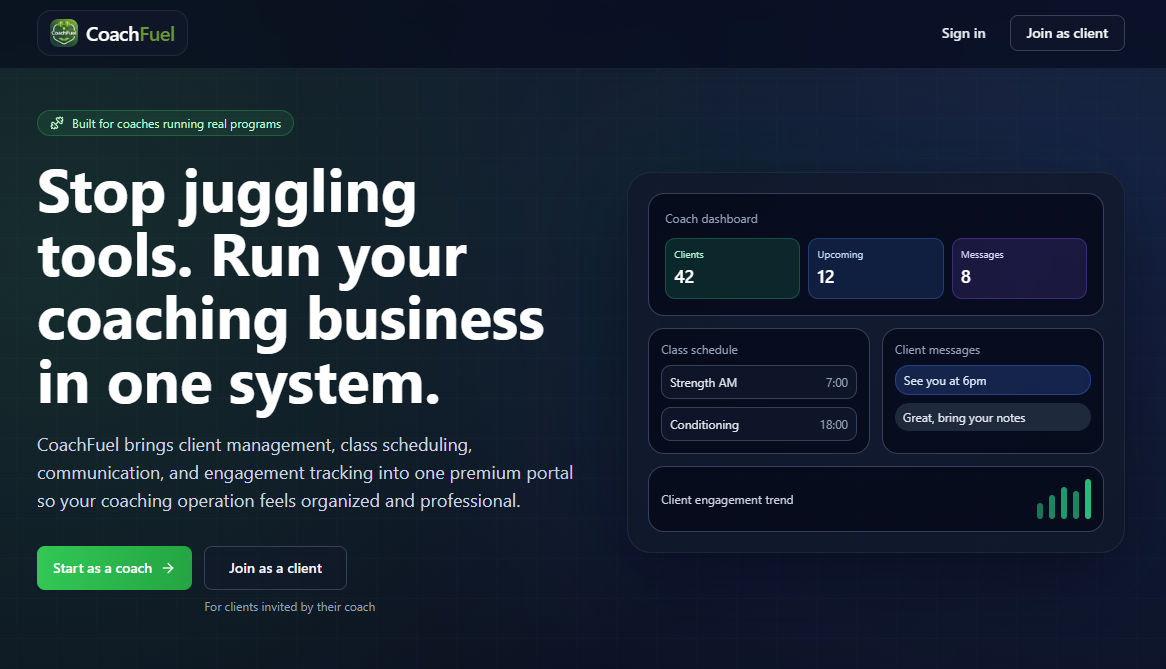
Built a full coaching operating system from scratch — client management, class tracking, real-time messaging, and Stripe payments across web and mobile.
The Problem
Coaches are running real businesses — tracking clients, managing schedules, communicating daily, and collecting payments — but most are doing it with a stack of tools that were never designed to work together. A spreadsheet for attendance. A messaging app for client communication. A separate calendar for scheduling. Venmo or a clunky payment processor bolted on at the end.
The result is operational drag. Coaches spend time managing their tools instead of managing their clients. Nothing talks to anything else. There's no single view of a client's progress, no centralized communication, no way to run the business as a coherent system.
The best coaches aren't lacking skill — they're lacking infrastructure. The goal was to build a system that matches the quality of their work.
The opportunity was clear: build a single, structured platform that handles every operational layer of a coaching business — client and class management, communication, attendance tracking, and monetization — so coaches can focus on coaching.
The Approach
I led CoachFuel as sole product manager and owner — responsible for product strategy, system design, architecture decisions, and feature prioritization across the full build. This was a B2B2C model from day one: coaches are the primary customer, but the product only works if clients have a genuinely useful experience too.
The first architectural decision was to build for the coach first. Before a single client-facing screen was designed, the core operational layer had to be solid: client roster management, class lifecycle management, attendance tracking, and engagement data. These aren't features — they're the foundation everything else depends on.
A coaching platform that coaches don't actually use every day isn't a platform — it's a side project. Every design decision was filtered through: does this reduce friction for a coach running their business in real time?
With the core data model in place — built on Supabase (Postgres + Auth) with a Next.js App Router frontend — the product expanded in deliberate layers. Real-time messaging came next, implemented on a socket-based architecture to support low-latency, contextual communication between coaches and clients. Not just a chat window — messaging tied to specific classes, activities, and events.
Notifications were designed with depth, not just breadth. Push notifications aren't useful if they land users on a generic dashboard. Every notification in CoachFuel deep-links directly to the relevant context — a specific class, a conversation, an actionable screen. That design choice matters for retention and daily engagement in a way that generic alerts never deliver.
Payments were integrated via Stripe with support for subscriptions, product-based purchases, and service offerings — giving coaches flexibility in how they structure and monetize their work. The mobile client experience was built in parallel with the web apps, ensuring that the experience coaches create carries through consistently to where clients actually engage: their phones.
The deliberate non-decisions mattered too. Social features, advanced analytics tiers, and product list sharing were explicitly deprioritized — not because they're bad ideas, but because depth in the core workflows was worth more than breadth across a wider surface area. A product that does four things extremely well beats one that does twelve things adequately.
The Results
CoachFuel shipped as a fully functional end-to-end coaching platform — not an MVP in the "barely works" sense, but a complete operational system that coaches can run their business on from day one.
- Complete coaching operating system. Client management, class lifecycle, attendance tracking, and engagement data — all in one structured system. No spreadsheets, no switching between tools.
- Real-time messaging, fully shipped. Socket-based architecture supporting low-latency, context-aware communication between coaches and clients — tied to specific classes and activity rather than a generic inbox.
- Deep-linked notification system. Every push notification routes users directly to the relevant screen — a specific class, conversation, or action item. Designed to drive daily re-engagement, not just awareness.
- Stripe monetization live. Subscriptions, product purchases, and service-based offerings fully integrated — giving coaches a flexible monetization layer without stitching together external tools.
- Three app surfaces, one coherent experience. Coach web app, client web app, and mobile client experience — built as a unified system, not three separate products. State, data, and communication stay consistent across all surfaces.
Building something similar?
Get a free 20-minute strategy call and we can talk through what is in the way.
Get a free 20-minute strategy call →